
Hi! I’m a PhD candidate in the Economics Department at the University of Chicago.
My research interests are in industrial organization & energy and environmental economics.
Working Papers
The Effects of “Buy American”: Electric Vehicles and the Inflation Reduction Act
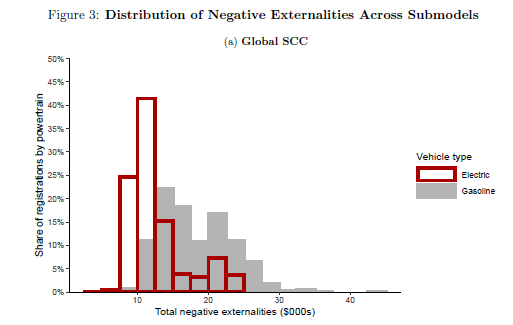
We provide the first ex post microeconomic welfare analysis of the electric vehicle (EV) tax credits in the Inflation Reduction Act (IRA). Relative to pre-IRA policy, the credits generated $1.96 in domestic benefits per dollar of government spending, with taxpayer cost of $36,500 per additional EV. Relative to having no EV credits, they yielded $1.11 in domestic benefits per dollar of government spending. A leasing loophole that sidestepped domestic content rules created negative domestic benefits. A prominent example of green industrial policy, the credits harmed foreign countries by shifting surplus to domestic producers and helped them by decreasing CO2 emissions.
Exact Simulation of Nested Logit Draws
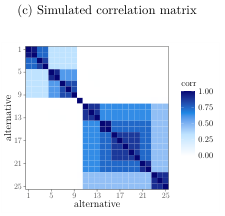
Nested logit models are simple to estimate, but nested logit errors have long resisted closed-form simulation. Galichon (2022) resolves a longstanding conjecture to show that nested logit errors decompose into standard Gumbel and positive stable components. I combine this result with the Kanter (1975) representation of positive stable variables to demonstrate a method for simulating error vectors for arbitrary trees. The method is fast, exact, and scales well. Monte Carlo simulations and timing benchmarks demonstrate its advantages over existing methods employing numerical inversion or moment-matching. It is a practical tool for discrete choice applications requiring full vectors of correlated shocks.
Works In Progress
"Salesforce Competition in Residential Solar"